The easiest answer is to start asking all of these platforms and doing the searches yourself directly. However, that probably won't give you a fantastic view, because it'll be on your own accounts and you might have other information logged in there that might skew toward you or away from you. And also, you probably aren't asking the right questions.
So the way I would actually go about this is to first think of the most common questions your customers ask you when they first reach out, and see who's actually getting cited for those. Then, if that's not you, move on to all the others and see if you're cited on any of the other platforms. What I would really focus on is logging all of the actual results. Search in ChatGPT, Claude, Perplexity, Grok, Copilot, Bing, Google and Gemini, and log who shows up and what pages it actually links to.
Why tracking AI citations isn't like tracking Google rankings
Google has its own software, Google Analytics and Google Search Console, that will tell you things like search volume and traffic directly. With AI search, you don't have direct first-party data coming from the AI telling you the exact amount of traffic. A lot of that traffic is hidden through different servers, assistants and agents. And in order to build a database, you would theoretically have to get first-party data from every single LLM you're trying to track, separately.
So instead, it's a lot more useful to track the percentage of the time you're showing up. Different answers get shown at different times for the exact same question. And everyone asks questions slightly differently. So you should really be testing the same question worded slightly differently, with probably between 5 and 20 variations of every question. Then ask each one to ChatGPT and all the others between 5 and 10 times.
Then go into a different version of the same platform. If you're using ChatGPT in a conversation where it's talking back to you, check that. Then go over to Claude and check it there, then in the Claude desktop app on your computer, then through the Claude API, and you're probably going to get three different answers to the same exact question.
If you want to be really accurate, you'd ask the 5 to 20 versions of the same question over and over on every one of those platforms and log all the answers. So just to track one question, you'd be doing hundreds of searches to know if you're ranking for that question at that one single time. And you should probably do this at least a handful of times a week if you want good data.
When SparkToro and Gumshoe.ai had 600 volunteers run the same prompts through ChatGPT, Claude and Google's AI nearly 3,000 times, the odds of getting the same list of brands twice were under 1 in 100, and the same list in the same order was closer to 1 in 1,000. (Search Engine Land)
Ahrefs found that Google's AI Mode and AI Overviews cite different sources 87% of the time for the same query. (Search Engine Journal)
What to actually track
You should be tracking whether or not you show up, and also who else shows up. More importantly than that, you should be tracking what it says about the top recommendation and where it pulled that information from, or where it's linking to directly.
Then you can see what types of pages it's actually citing, and what kind of information you need to have either to get recommended in the first place, or that you should be making more of to get recommended more if you're already showing up.
And you should log how often you're showing up and create a citation percentage for yourself.
Your tracking sheet should log, for every search:
- Did you show up?
- Who else showed up?
- What did it say about the top recommendation?
- Which pages did it cite or link to?
- Your citation percentage over time
How to check it yourself for free
The simplest way to do this is to think of the top 5 or 10 questions you get asked all the time by customers, and put them all in a spreadsheet.
Then go into something like ChatGPT or Claude and ask it to give you a fan-out of the different questions an LLM could ask when it's searching a question like that. You want about 5 to 10, or even 20, versions of that question. "Fan-out" is the term that will most likely get you the right result. Log all of those fan-out questions in your spreadsheet. So you have your main question, and then, let's say, five fan-out versions of it below it, and you have that for every one of your questions. If you're tracking five questions and each has five versions, you're tracking 25 different questions. But really, it's five main ideas you're trying to track.
Then go to every one of the platforms, log out of your normal account, and maybe make a different one that's not tied to you and doesn't have any other history on it. Keep it as simple as possible. Just ask the questions, and don't really interact with it much, so it stays a plain account. Do that for every platform.
So you have 25 questions to search. You should probably search each of them about five times, so you're already up to 125 searches, and you're going to do that on all eight platforms. By the end, you're up to about 1,000 searches for one round of checking. It adds up really quickly if you want an accurate picture of your results.
The math for one round of checking
5 questions × 5 fan-out versions = 25 questions
25 questions × 5 runs each = 125 searches
125 searches × 8 platforms = 1,000 searches
"Query fan-out" is Google's own term: Google says AI Overviews and AI Mode may run multiple related searches across subtopics and data sources to build a single answer. (Google Search Central)
Monitoring tools vs. done-for-you
Tools like Profound, Otterly and Peec do automate the tracking. I can't verify the exact amount of fan-outs, queries and tracking they're actually doing.
I don't want to badmouth any other companies. But I have spoken with people at many of the large software companies, and a lot of them are not searching the LLMs in the most thorough way. A lot of companies just use third-party data, package it up and process it slightly differently. Other companies use what are called headless browsers. Others only use APIs. Others use a mixture.
Truthfully, the most accurate way to do it is to have a mixture of data coming from real desktop app usage, real iOS and other mobile app usage, real browser data, API data and third-party data, and then mix all of it so you have a proper picture of how each platform is actually citing for a specific query. And you should be doing that at scale. When you ask a lot of these companies where their data comes from, they're somewhat cryptic and will tell you it's proprietary and a secret. But if they're not tracking it on every platform, in every different way, and verifying it by doing those searches in different ways, then they're not really giving you an accurate picture.
What they're great for is a temperature check, and sometimes their analytics of that data is really solid. But I wouldn't view any of their information as 100% correct. I'd view it more as a directional thermometer, so you can get a heat check on where things are going. Are you generally getting cited more or not? They can probably give you reasons why and analyze other things. But they're also moving into a bunch of different products now, because they're realizing that tracking alone often isn't a product in and of itself.
I truthfully think these AI visibility trackers are going to get more and more accessible as time goes on. And if all you're doing is tracking, you don't have any results to show for it. A lot of teams, companies, founders and owners don't really want to just know what's going on. They want it to be fixed.
Tracking alone won't get you cited: what to do with the data
What you do with that data is definitely the most important part of the process. You now have a baseline of which companies, pages and information are getting cited the most. You'll start to see a lot of similarities between the different pages and the things being talked about.
What you need to do is make sure that information is spelled out very clearly on your website, and put up multiple pages that address that type of content. Make pages that answer the same questions and give similar types of answers, but from your own point of view and your own perspective. Share real human experiences, because AI loves that. It's unique, and it shows that you're an expert.
Create the pages it's citing:
- If it's citing case study pages, create case study pages.
- If it's citing resource pages, create resource pages.
- If it's citing technical pages, create technical pages.
Then make them work for you with the data and information you already have as a company, because that's just what other people are doing. Your data and your experiences are unique, which means they're valuable.
Then follow general best practices when you make these pages:
- Create a good summary at the top that's easy to read.
- Make sure the technical structure is good.
- Make sure your schema markup is how it should be.
- Make sure your headers, H1s and H2s are laid out how AI likes to read them.
- Have a section that lays out the exact questions and answers that are most popular.
- Make sure it's not written by AI, because it can tell.
Google and Anthropic have both updated their policies, and they've both addressed origin and authorship. Google specifically calls out fake author profiles. And Anthropic is now talking a lot about people who are trying to pass off AI writing as being authored by real human experts. So if you're ever trying to pass it off as if it was written by a human expert and it really wasn't, you're essentially lying to the systems reading it. They've pretty explicitly said they don't want that in their policies.
So I think that's going to be much more widely implemented wording, and I think LLMs getting more specific in their policies is going to skew away from any sort of AI content not being labeled or being passed off as human. That's technically just my opinion, but I do think that's the direction everything has been going in, and it's going to keep going in that direction.
So just don't use AI. Just talk to the camera or voice-to-text everything, and make sure everything has proper grammar but a real, natural language tone.
How Attractify tracks it, including leads and sales
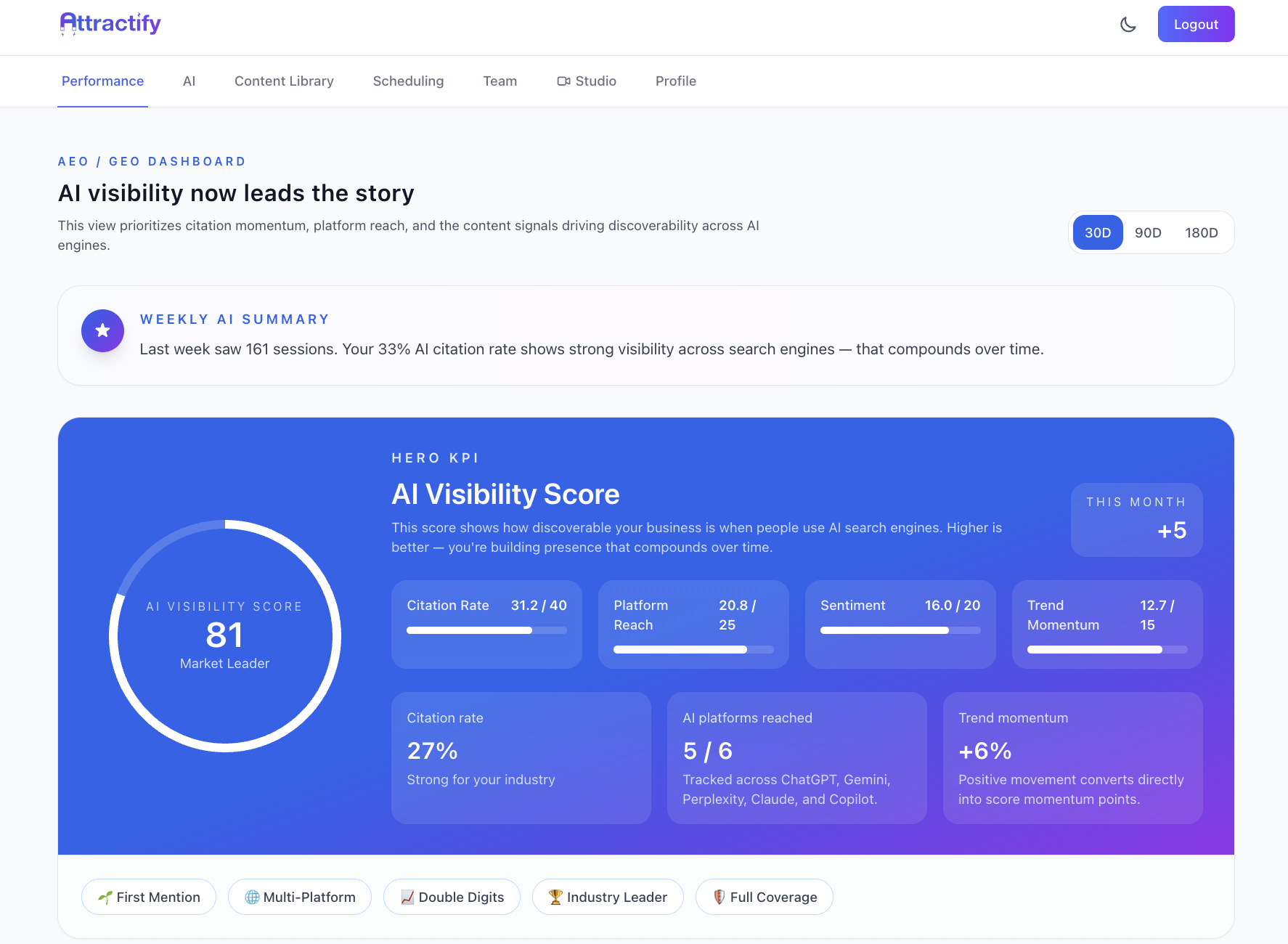
We're doing all of this, but at an even bigger scale, for every one of the questions and queries we're targeting for every one of our clients. So we have amazing data from thousands of citations being pulled and logged. All of the information about who's showing up, what pages are getting cited, and what information is actually getting cited is put into our database, which is constantly optimizing the way we optimize every client's posts. And that happens in real time, all the time.
We mix a lot of those different types of data, and we're running thousands of citation tests all the time. Then we're actually implementing what our data is showing, in a way that no human could by just taking some advice from a dashboard and running with it. We're doing all the technical work and technical optimization that no human really ever could. I think that's where the real value of this kind of marketing comes from, not just from a report.
Attractify also tracks the leads and sales generated directly from AI traffic. We do that with our own proprietary attribution model, which combines our AI citation data, cross-references it with your website's actual traffic and clicks, and then combines other tags we have in place that track the entry points people take to your website. That shows whether leads, sign-ups, form fills or sales came directly from someone clicking a link in AI search and landing on your website.
See where you stand: get a free AI visibility scan →
FAQ
What's a good AI citation rate?
That can definitely vary by your industry and what kinds of things you're searching. Are you in a super niche, low-competition market? In that case you really should be way higher, probably above 50% if you're doing good GEO work. But if you're in a market with a lot of competition, 20% could be 20% of millions of searches, which is massive. It's important to realize how competitive your market is, and how competitive the queries you're trying to get recommended for are.
As a benchmark, a lot of companies start out under 20% when you blend the percentages of all the queries they're tracking, including branded queries. When you have 30 to 40% citation rates, that's usually great traction. Between 50 and 70%, you're probably getting a lot of traffic, leads and sales, as long as you're tracking it for the right queries. If you're tracking really high buyer-intent queries, which are way harder, then even 50% is probably going to get you a lot, and that traffic will be very high converting compared to people who find your site through awareness, discovery or education content.
I don't think most businesses are going to get above that 50 to 60% range without doing something intentional or getting professional help. It's not impossible, but getting above a 60% citation rate in a competitive industry, when you're only tracking high buyer-intent queries, is very difficult. We've done it, but that's because our software is able to self-optimize based on massive amounts of data, in real time, constantly checking and testing.
| Blended citation rate | What it usually means |
|---|---|
| Under 20% | Where most companies start |
| 30–40% | Great traction |
| 50–70% | Real traffic, leads and sales (on the right queries) |
| 60%+ on high-intent queries in a competitive industry | Very difficult without professional help |
If I rank well on Google, will I show up in ChatGPT?
Ranking well on Google most certainly does not guarantee you're going to show up in ChatGPT or other AI platforms. A lot of the time, when a company shows up really well in Google, it means their old SEO tactics worked, because that was their goal. But that kind of content and information doesn't always cross over to what these AI platforms actually want. Often it's because the content doesn't answer a necessary question, or it wasn't made in a way AI can easily read, understand or verify.
Search engines have changed over time, and AI engines, answer engines and generative engines, essentially anything backed by an LLM, are often looking for slightly different things, or need more context and more points of contact with an idea before they feel they can trust it. SEO also had a lot to do with how Google viewed your site. But if you're not using a system that relies on Google, then Google's long-built trust in your website, because it knows you've been a good source in the same industry for a long time, doesn't really matter. Google isn't sharing that information publicly anyway, so ChatGPT has no way of tracking it or really caring about it. You don't get the same legacy treatment that brands with historically strong Google rankings got. You really need to create the type of content AI wants to cite, can understand easily, and can verify in different places.
Which AI platforms matter most to track?
Certain industry professionals often skew toward one or two platforms, but in general, the most important ones to check are ChatGPT, Claude and Gemini. If you're willing to really analyze the data for what's getting cited and dive in more, Perplexity is another great one to add, and their tools are really phenomenal.
Claude can be tricky, because the answers you get from the API, a browser, the Mac app and your phone app will often vary quite a bit, so the data can be difficult to analyze. ChatGPT has similar difficulties, but in certain industries it can have less variation in its answers across the different versions.
OpenAI reported 1.2 billion weekly ChatGPT users at DevDay on September 29, 2026 (Whizi), and Google said the Gemini app passed 1 billion monthly active users in August 2026 (iPhone in Canada).
How often should I check my AI citations?
For the average person, this is a lot of work. We run our tests multiple times throughout every week to create real-time data our customers can look at live on their dashboard. But most people doing this themselves, unless it's literally their full-time job, probably won't be able to implement changes more often than once every couple of weeks. So my recommendation for a DIYer is to check every two weeks, so you have a good, consistent amount of data you can graph out.
If you're a professional doing this, I'd definitely check weekly, or even multiple times a week if possible. You're not going to get actionable information every single week, but it creates more data points for when you're looking at the trajectory later, and you'll have better, more accurate measurement.
Sources
- Search Engine Land, "AI recommendation lists repeat less than 1% of the time: Study" (SparkToro / Gumshoe.ai). https://searchengineland.com/ai-recommendation-lists-rarely-repeat-study-468076
- Search Engine Journal, "AI Recommendations Change With Nearly Every Query: SparkToro" (incl. Ahrefs AI Mode vs. AI Overviews data). https://www.searchenginejournal.com/ai-recommendations-change-with-nearly-every-query-sparktoro/566242/
- Google Search Central, "AI features and your website" (query fan-out). https://developers.google.com/search/docs/appearance/ai-features
- Delante, "Google Tightens Its Approach to AI Content: What Changed in Late September and Early October 2026?" (deceptive authorship, fictional author profiles). https://delante.co/google-tightens-its-approach-to-ai-content-what-changed/
- Anthropic Usage Policy (effective November 12, 2026). https://www.anthropic.com/legal/aup
- Search Engine Journal, "Claude's New Rules Target Fake Sources Built To Sway AI Answers." https://www.searchenginejournal.com/claude-rules-fake-sources-ai-answers/592456/
- Whizi, "ChatGPT statistics 2026: 1.2 billion weekly users." https://whizi.io/resources/chatgpt-statistics/
- iPhone in Canada, "Google Gemini App Surpasses 1 Billion Monthly Active Users" (Aug 12, 2026). https://www.iphoneincanada.ca/2026/08/12/google-gemini-app-surpasses-1-billion-monthly-active-users/